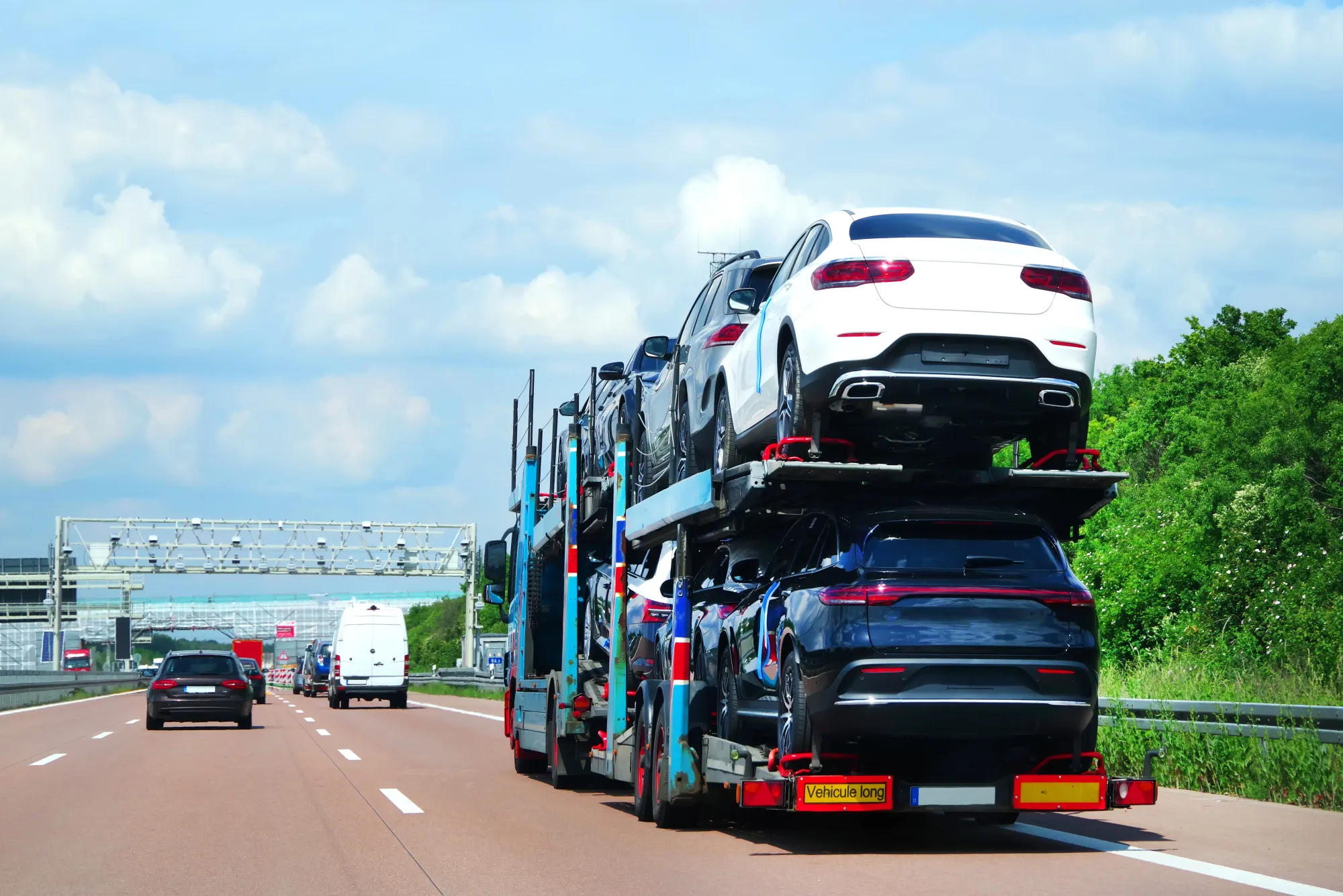
There are basically two ways to transport a second-hand vehicle: by specialised transport (cranes, car transporters or vehicle logistics companies) or with a driver who takes it by road to its destination.
In general terms, specialised transport offers greater protection and less wear and tear, while transport with a driver is usually more flexible and, in some cases, more economical in the short term.
The best option will depend on the type of vehicle, the distance, your budget and whether you are a private individual, importer or dealer.
Specialised transport
Specialised transport consists of moving the vehicle without it travelling on the road.
It is commonly used for imports, professional sales and deliveries between dealerships.
Types of specialised transport
1. Open car transporter
This is the most common type. It allows several vehicles to be transported simultaneously, reducing the cost per unit.
It is common on national and international routes within the European Union.
2. Closed car transporter
This is used for high-value, classic or sports vehicles. It offers protection from the weather, dirt and possible impacts.
3. Individual tow truck or platform transport
Ideal for short journeys, broken-down vehicles or vehicles without temporary documentation to drive.
4. Comprehensive vehicle logistics
Specialised companies manage collection, transport, temporary storage, document management and even registration at the destination.
Advantages and disadvantages of specialised transport
Advantages
- No additional mileage: the vehicle does not accumulate mechanical wear and tear.
- Greater legal and insurance security: transport is usually covered by goods insurance.
- Ideal for imports from countries such as Germany, France or Italy.
- Time savings for companies that move several vehicles per month.
Disadvantages
- It can be more expensive for short journeys.
- Dependence on logistics deadlines and route availability.
- In open transport, the vehicle may be exposed to the weather (although without mechanical wear).
Transport with driver
In this mode, a professional driver or the buyer themselves drives the vehicle to its destination. This is common in purchases between private individuals or when the car already has a valid registration and insurance.
Modes of transport with driver
1. Professional driver
Specialised companies send a driver to collect the car and deliver it by driving it.
2. In-person purchase and return by road
The buyer picks up the vehicle and drives it to their city.
3. Transport with temporary or export plates
In international transactions (e.g. from Germany), temporary registration plates and temporary insurance are used to drive legally.
Advantages and disadvantages of transport with driver
Advantages
- Immediate speed if the vehicle is roadworthy.
- It can be more economical for medium distances.
- It allows you to test the vehicle in real conditions.
Disadvantages
- The car accumulates additional kilometres.
- Greater risk of breakdowns on long journeys.
- Exposure to accidents or incidents on the road.
- Requires valid documentation and insurance.
Which option to choose?
The decision depends on your profile and the type of operation:
- Individuals buying locally: it may be worth driving the vehicle if it is in good condition and insured.
- Importers or second-hand car dealers: specialised transport is usually more cost-effective and safer in the medium term, especially if several vehicles are being transported.
- High-end, classic or unroadworthy vehicles: transport by closed lorry or flatbed is recommended.
- Long distances or international transport: professional logistics is usually advisable to avoid risks and legal complications.
Frequently asked questions
We answer the most common questions about road vehicle transport.
Is it cheaper to transport a car by driving it?
It depends on the distance. For short journeys it may be cheaper, but for long distances the cost of fuel, tolls, temporary insurance and possible risks may equal or exceed the cost of specialised transport.
Which option is safer?
Specialised transport offers greater protection, especially if it is carried out in a closed lorry and with goods insurance.
Does the vehicle lose value if it is driven to its destination?
Yes, because it accumulates additional kilometres and mechanical wear and tear.
Can a car be transported without an MOT?
If it cannot be legally driven, it must be transported by tow truck or car transporter.
What happens with international imports?
Provisional number plates and insurance are required to drive. In many cases, it is more practical to hire specialised transport to avoid paperwork and risks on the road.
How long does specialised transport take?
It depends on the route and availability, but domestic transport usually takes between several days and a week; international routes may take a little longer.
Conclusion
In short, if you prioritise safety, preservation and professionalism, specialised transport is the most reliable option.
If you are looking for immediacy and lower one-off costs, transport with a driver may be sufficient.
Consider the distance, mechanical condition, documentation and value of the car. Making the right choice not only affects the cost, but also the safety and preservation of the vehicle.


